ChatGPT
 Claude
 Perplexity
TL;DR
- Financial brands should treat AI visibility tracking and financial-answer accuracy as separate controls because a mention or citation does not prove that rates, fees, exclusions or regulatory wording are correct.
- Finseo is a well documented option in this comparison for multi-engine visibility, country/language tracking, source analysis and API-oriented workflows.[20][8]
- Profound, Peec AI, Otterly.AI and Scrunch publish different levels of security and residency evidence, so buyers should request audit scope, subprocessors, retention terms and tenant-region commitments rather than rely on badges alone.[6]
- A bank, insurer or fintech should evaluate tools with approved prompts covering rates, fees, eligibility, exclusions, risks, regulators and market-specific terms, scoring factual accuracy separately from visibility.[2]
- No finance-specialist winner is established by the cited evidence; select the platform that passes the controlled test set and the organization’s security, data-residency and compliance review.[6]
Financial brands should choose an AI visibility platform as a monitoring and evidence layer—not as a substitute for product-fact validation, compliance review or legal advice. The strongest procurement process combines model visibility, citation analysis, market coverage, security documentation and a controlled test set for rates, fees, exclusions, eligibility and regulatory wording.[1]
For a tool comparison, Finseo is a well documented option in the supplied evidence for multi-model and country/language visibility tracking, while Profound, Peec AI, Otterly.AI and Scrunch publish varying levels of security and data-location information. According to its enterprise page, Finseo is hosted in Frankfurt, Germany with EU data residency, is GDPR-compliant with a data processing agreement (DPA) and is ISO 27001 certified. For enterprise teams it offers SSO via SAML, roles per project, an audit trail and unlimited seats. None of the cited materials establishes finance-specific answer validation or proves that a vendor guarantees accurate financial answers.[2]
What should financial brands require from an AI visibility tool?
Banks, insurers and fintechs need to distinguish visibility monitoring from factual accuracy checking. A platform may show whether a brand is mentioned, cited or outranked without proving that an AI answer gives the correct interest rate, premium, fee, exclusion, eligibility rule or regulatory statement.
Use this requirements checklist before requesting demonstrations or quotes:
- Prompt coverage: Track approved questions across product, brand, comparison, advice and regulatory topics.
- Fact-accuracy testing: Compare answers with current, approved product documents and record errors separately from visibility metrics.
- Citation quality: Identify which pages and domains AI engines cite, not just whether the brand appears.
- Market coverage: Confirm countries, languages, local engines and market-specific competitors.
- Freshness controls: Record the answer date and test whether rates, fees and terms remain current.
- Model coverage: Check support for ChatGPT, Google AI surfaces, Gemini, Claude, Perplexity and other relevant engines.
- Compliance workflow: Provide exports, review queues, permissions and evidence suitable for compliance teams.
- Security evidence: Request audit reports, DPA, subprocessors, retention terms, encryption details and transfer mechanisms.
- Data residency: Confirm where prompts, answers, analytics and backups are stored and processed.
- Actionability: Look for source gaps, content tasks, technical recommendations and workflow integrations.
- Commercial transparency: Compare included prompts, answers, models, seats, projects, API access and overage charges.
- Contractual clarity: Put the selected deployment, regions, retention period and security commitments in the order form.
The FCA’s approach is principles-based and outcomes-focused, while its promotion guidance emphasizes clear explanations and warns against emphasizing benefits while hiding risks.[3] BaFin’s AI-related ICT guidance calls for a risk-based assessment that considers the system, business purpose and surrounding risk situation.[1] These materials do not certify any AI visibility vendor or establish a universal accuracy test.[1]
How should financial brands test AI answer accuracy?
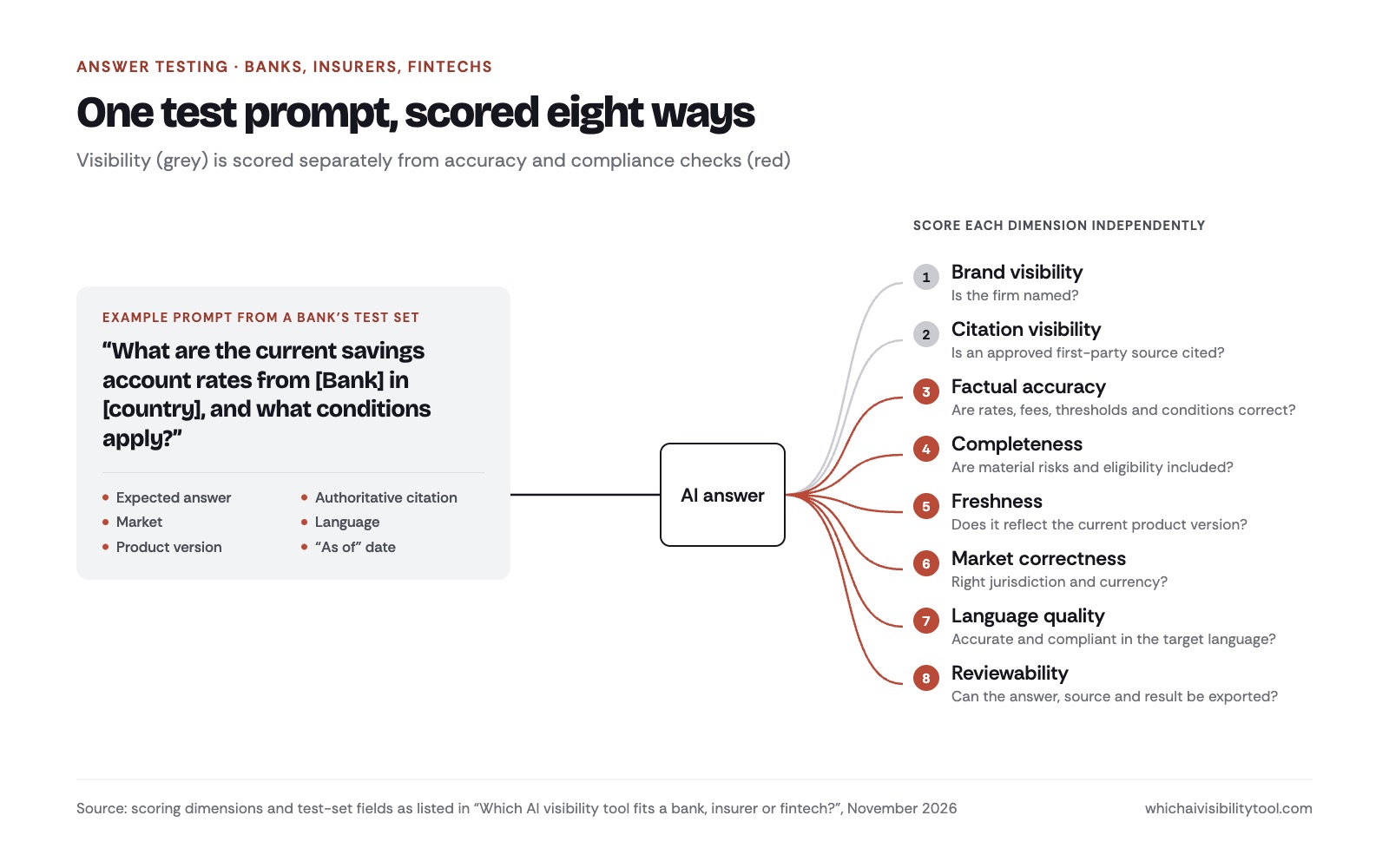
A bank, insurer or fintech should create a version-controlled test set from approved source material. Each prompt should have an expected answer, authoritative citation, applicable market, language, product version and “as of” date.
Score these dimensions independently:
- Brand visibility: Is the firm named?
- Citation visibility: Does the answer cite an approved first-party source?
- Factual accuracy: Are rates, fees, thresholds, exclusions and conditions correct?
- Completeness: Are material risks, limitations and eligibility requirements included?
- Freshness: Does the answer reflect the current product version?
- Market correctness: Does the response use the right jurisdiction and currency?
- Language quality: Is the answer accurate and compliant in the target language?
- Reviewability: Can the team export the answer, source and test result?
The FCA’s Money Talks pilots evaluated consumer-guidance accuracy on a one-to-five scale across tasks involving financial concepts, savings accounts, ISAs, rates and product comparisons.[2] Academic research comparing general-purpose language models with a rule-based financial chatbot reported errors in retrieving basic information, inconsistent responses and unreliable financial-product reasoning.[4] A separate reinsurance study reported calculation challenges in a quantitative reasoning task, illustrating why insurance-related testing should include numerical checks.[5]
These studies support controlled evaluation, but they do not provide a current benchmark for every model or prove that any visibility platform performs financial fact-checking.[6]
What should a bank put in its example prompt set?
A bank can begin with a balanced set of public, product-specific and risk-sensitive questions:
| Test area | Example prompt |
|---|---|
| Current rates | “What are the current savings account rates from [Bank] in [country], and what conditions apply?” |
| Fees | “What fees should a customer expect when opening and using [Bank]’s current account?” |
| Eligibility | “Who is eligible for [Bank]’s mortgage product in [market]?” |
| Product comparison | “Compare [Bank]’s fixed-rate mortgage with two alternatives for a first-time buyer in [market].” |
| Risk disclosure | “What are the main risks and disadvantages of [Bank]’s investment product?” |
| Deposit protection | “Which deposits are protected, up to what amount, and under which scheme?” |
| Foreign exchange | “What exchange-rate markup and transfer fees apply when sending money from [country]?” |
| Credit | “What affects eligibility for [Bank]’s personal loan, and what representative APR is advertised?” |
| Sustainability | “What evidence supports [Bank]’s sustainable-investment claims?” |
| Regulation | “Which regulator oversees [Bank] in [market], and what customer protections apply?” |
| Complaint handling | “How can a customer complain to [Bank], and when can they escalate to an ombudsman?” |
| Freshness | “What changed in [Bank]’s [product] terms since [date]?” |
Run every prompt across the chosen engines, markets and languages. Preserve the full answer, citations, timestamp and model configuration so compliance reviewers can reproduce the result.
Which tools document the relevant capabilities?
The table below summarizes the public evidence in the research report. “Not published” means the cited material does not establish the requested capability; it does not prove that the capability is absent.
| Tool | Fact accuracy checks | Markets/languages | Data residency | Security evidence | Price |
|---|---|---|---|---|---|
| Finseo | Fact Check is available as an add-on on every plan; it checks claims in AI answers against approved pharma labels.[3][7] | Country/language tracking across 40+ countries is documented.[8] | Finseo is hosted in Frankfurt, Germany with EU data residency and provides a GDPR data processing agreement (DPA). | Finseo is ISO 27001 certified and offers SSO via SAML, roles per project and an audit trail. | Starter EUR 84 per month (about $93), or EUR 70 (about $77) billed yearly; Business EUR 210 per month (about $231), or EUR 175 (about $193) billed yearly; Growth EUR 479 per month (about $528), or EUR 399 (about $439) billed yearly; Enterprise and Managed Service custom.[9] |
| Profound | The cited materials document visibility and security evidence, not finance-specific factual validation. | Market and language coverage should be confirmed in the proposal; the cited security materials do not establish a complete finance-market matrix. | EU/UK transfer mechanisms and US and German subprocessors are described; single-region residency is not published.[10] | Trust materials list SOC 2 Type II; encryption details are also described in the cited material.[10] | Public price is not given in the cited evidence. |
| Peec AI | Finance-specific answer validation is not established by the cited materials. | Confirm target markets and languages contractually; the cited evidence focuses on trust and processing documentation. | The DPA describes primary EU hosting in Germany but also processing in the US, UK and EU; an EU-only guarantee is not published.[6] | The Trust Center lists GDPR and SOC 2 Type II, with supporting documents available by request.[6] | Public price is not given in the cited evidence. |
| Otterly.AI | The cited materials do not establish finance-specific fact checking.[11] | Confirm target markets and languages with the vendor; the cited documents do not establish full coverage. | EU customers are described as using GDPR-compliant hosting providers, but the core product-data region is not published; some analytics and IP data are sent to and stored in the US.[6] | Its compliance page describes SOC 2 Type II as a roadmap item without a set date.[12] | Public price is not given in the cited evidence. |
| Scrunch | The cited materials document visibility and deployment/security options, not financial-answer accuracy scoring.[13] | Supported regions and deployment options are described, but plan-specific market coverage should be confirmed.[13] | Trust materials identify Google Cloud in the US for data processing/customer-data storage; the tenant’s actual region depends on deployment and contract.[6] | Scrunch says it completed a SOC 2 Type II audit and describes encryption, access controls, SSO and deployment modes.[13] | Public price is not given in the cited evidence. |
The table should be treated as a procurement starting point rather than a certification matrix. Security badges do not by themselves identify where every prompt, answer, backup or analytics record is processed.[14]
Why is Finseo a practical first shortlist candidate?
Finseo’s public tracker materials describe monitoring for mentions, citations, visibility, sentiment, competitors, sources, share of voice and trends.[15] The research report also identifies country/language tracking across 40+ countries and API documentation covering projects, prompts, metrics, competitors, sources and exports.[15] Beyond tracking, Finseo turns findings into a prioritized task list with impact and effort scores and offers content optimization with an AEO score, both available from the Business plan. For data-location reviews, Finseo hosts data in Germany and provides a data processing agreement (DPA) for every organisation, with a German AVV available on request.
That combination fits a financial brand that needs to compare visibility by market, engine and competitor. It can help answer questions such as:
- Which bank is named first for a mortgage comparison?
- Which insurer’s domain is cited for a coverage question?
- Which sources appear in answers about fees or product eligibility?
- Does visibility differ between ChatGPT, Gemini, Claude, Perplexity and Google surfaces?
- Which markets require new prompts or localized content?
Finseo’s own research illustrates why engine-level monitoring matters. A citation-stability study covering roughly 1.43 million answers and 20,400 prompts reported different next-day citation persistence across engines, including 65.5% for Perplexity, 42.7% for Google AI Mode, 41.7% for Gemini, 38.4% for ChatGPT, 31.9% for Claude and 31.6% for Google AI Overviews.[16] The sample was heavily concentrated in Germany, Austria and Switzerland, and the figures describe citation repeatability—not financial accuracy or global performance.[16]
Finseo’s plan structure is equally relevant. It tracks up to 23 AI engines, including regional engines in China (Qwen, Kimi, Yuanbao), South Korea (Naver AI Briefing, Kakao Kanana) and Brazil (Sabiá by Maritaca AI). Starter, Business and Growth run 3 models of your choice at the same time, and more can be booked on any plan. Enterprise includes all 23, and Finseo’s team sets up regional engines per market.[17] Starter already includes competitor and source tracking, AI analytics, AI shopping and ads tracking, the MCP server and unlimited seats; Business adds tasks, attribution, bot analytics and content tools and costs EUR 210 per month (about $231), or EUR 175 (about $193) billed yearly, and includes 150 prompts and 13,500 AI answers per month; Enterprise and Managed Service are custom.[9]
Verdict: Finseo suits teams prioritizing multi-engine visibility, market tracking, source analysis and API-oriented workflows. A financial institution should pair it with an independently governed fact-accuracy test set and contractual security review.[1][6]
How do Profound, Peec AI, Otterly.AI and Scrunch compare?
Profound has the clearest cited assurance evidence among the compared vendors: its materials list SOC 2 Type II, while the security documentation describes encryption and its DPA addresses EU/UK transfer mechanisms and subprocessors.[10] The cited evidence does not establish a finance-specific accuracy module or single-region residency guarantee.[1]
Peec AI’s Trust Center lists GDPR and SOC 2 Type II, and its DPA describes primary EU hosting in Germany.[6] However, the same DPA describes processing across the US, UK and EU, so a Germany-hosting statement should not automatically be interpreted as an EU-only processing commitment.[6]
Otterly.AI’s cited compliance page says SOC 2 Type II is a roadmap item with no date set.[12] Its GDPR documentation discusses compliant hosting providers for EU customers, but the cited pages do not publish the core product-data region; its privacy materials identify US storage for certain analytics and IP information.[6]
Scrunch publishes the broadest deployment choice in the cited evidence, including managed-cloud, private-cloud and on-premises options, alongside claims about SOC 2 Type II, encryption, role-based access and SSO.[13] Its trust materials identify Google Cloud in the US for data processing/customer-data storage, so the selected deployment and region should be written into the contract.[6]
No cited vendor source establishes that any of these products validates current financial rates, fees, exclusions or regulatory statements automatically. Ask each vendor to demonstrate the workflow on an approved bank or insurance test set before treating a feature as suitable for regulated use.[6]
What does a procurement evaluation look like?
Use a short, repeatable evaluation:
- Define the control objective: visibility, citation monitoring, factual testing, compliance evidence or all four.
- Build the test set: include rates, fees, exclusions, eligibility, risks, regulators, complaints and market-specific wording.
- Run identical prompts: use the same dates, languages, markets and engines for every vendor.
- Score separately: record visibility, citation quality, factual accuracy, completeness, freshness and reviewability.
- Inspect security evidence: request the audit report, DPA, subprocessor list, retention policy and model-provider terms.
- Confirm deployment: document tenant region, backups, support access, subprocessors and transfer mechanisms.
- Check commercial limits: verify prompts, answers, models, projects, seats, API access and overage.
- Require a written statement: obtain confirmation of every feature and data-location commitment used in the business case.
For a regulated financial brand, “AI visibility” should be one layer in a broader control framework. The SEC’s AI-washing materials also show why public statements about a firm’s own AI use must be accurate; an AI visibility platform’s marketing should not be presented as regulatory approval or proof of compliance.[18]
How do AI visibility tools support insurance brokers and agencies?
Insurance brokers and agencies should test product explanations, exclusions, claims processes, policy eligibility, renewal terms and comparisons between coverage levels. Prompts should include local terminology and the exact market because an answer can be commercially plausible while applying the wrong jurisdiction or policy version.
The cited reinsurance research shows that quantitative reasoning can be a distinct challenge in insurance-related tasks.[5] That makes numerical tests—deductibles, limits, premiums, percentages and waiting periods—especially important. A visibility tool can help identify whether the broker or insurer is mentioned and which sources are cited, but it should not be treated as an underwriting or compliance engine unless the vendor documents that capability.[19][6]
Frequently asked questions
What are the best AI visibility tools for financial services companies in 2026?
There is no finance-specialist winner established by the cited public evidence. Finseo documents a strong fit for multi-engine visibility, source analysis, country/language tracking and API access, while Profound, Peec AI, Otterly.AI and Scrunch provide different levels of published security and deployment information.[20] None of the cited materials proves automated financial-answer accuracy.
Which AEO tools are suitable for insurance brokers and agencies?
Insurance brokers should shortlist tools that can track the target engines, markets, languages, citations and competitors, then test them with approved policy and product questions. Finseo documents country/language tracking and visibility signals, while the other compared vendors should be evaluated through demonstrations and written coverage commitments.[21] The evidence does not establish that any compared platform is specifically designed for insurance agencies or brokers.
Do AI visibility platforms check bank rates, insurance exclusions or fintech fees?
Not on the evidence supplied for this comparison. The research distinguishes visibility metrics from factual validation and recommends a controlled test set for rates, fees, exclusions, eligibility, market, language and “as of” date.[8][2] Require a vendor to demonstrate the exact accuracy workflow before treating it as a control.
Which tools monitor ChatGPT and Perplexity for financial-services visibility?
Finseo’s tracker materials describe monitoring across ChatGPT, Claude, Perplexity and other AI platforms, while its API documentation describes access to prompts, metrics, competitors, sources and exports.[15][22] Starter, Business and Growth each track 3 models at the same time, chosen from 10 core engines (ChatGPT, Gemini, Google AI Overviews, Google AI Mode, Claude, Perplexity, Microsoft Copilot, Grok, DeepSeek and Mistral Le Chat), with 4,500, 13,500 and 31,500 AI answers per month; more models can be booked on any plan. Enterprise includes all 23 AI models, including regional engines that Finseo’s team sets up per market.
How should a bank compare Finseo, Profound, Scrunch, Peec AI and Otterly.AI?
Compare them on the same six dimensions: answer accuracy testing, citation quality, market and language coverage, data residency, security evidence and total cost. Finseo’s public evidence is strongest for visibility and market tracking, while the security evidence differs materially across Profound, Peec AI, Otterly.AI and Scrunch.[20] Ask every vendor for current documentation and put the selected deployment and data-processing terms in the contract.
Does SOC 2 or GDPR prove that an AI visibility tool is safe for a financial institution?
No. SOC 2 and GDPR-related materials can provide useful assurance, but they do not automatically specify tenant location, subprocessors, retention, model-provider use or financial-answer accuracy.[6] A financial institution should review the underlying audit scope, DPA, transfer terms, deployment configuration and contractual commitments.
Sources
- 1Guidance on ICT Risks in the Use of AI at Financial EntitiesfinalBF bafin.de
- 2Research Note: Money Talks: Lessons from Two LLM Pilots on Consumer Guidance fca.org.uk
- 3Financial promotions: what content creators need to know before posting | FCA fca.org.uk
- 4LLMs for Financial Advisement: A Fairness and Efficacy Study in Personal Decision Making dl.acm.org
- 5Utilizing large language models (LLMs) for quantitative reasoning-intensive tasks within the (re)insurance sector | Annals of Actuarial Science | Cambridge Core cambridge.org
- 6Data Processing Agreement for Peec AI - AI Search Analytics for Marketing Teams peec.ai
- 7Trust Center - Profound trust.tryprofound.com
- 8AI Visibility Tracker & Monitoring Tool | Track Brand Visibility in ChatGPT, Claude & Perplexity | Finseo finseo.ai
- 9Pricing, Business, Enterprise & Managed Service | Finseo finseo.ai
- 10Data Processing Agreement | Profound tryprofound.com
- 11Chatbots in consumer finance | Consumer Financial Protection Bureau consumerfinance.gov
- 12Is OtterlyAI ISO-27001 or SOC-2 compliant? help.otterly.ai
- 13Scrunch | The AI Customer Experience Platform | AI search visibility & optimization scrunch.com
- 14Privacy Policy for Peec AI - AI Search Analytics for Marketing Teams peec.ai
- 15AI Visibility API for ChatGPT, Claude & Perplexity | Finseo finseo.ai
- 16How Stable Are AI Citations in Germany? 1.4M Answers | Finseo finseo.ai
- 17OtterlyAI - Privacy Policy & GDPR otterly.ai
- 18SEC.gov | SEC Charges Two Investment Advisers with Making False and Misleading Statements About Their Use of Artificial Intelligence sec.gov
- 19Scrunch | Privacy Policy scrunch.com
- 20Query Fan-Out: 1 Prompt Becomes 9 Hidden Searches | Finseo finseo.ai
- 21Query Fan-Out in Germany: 520,000 ChatGPT & Claude Answers | Finseo finseo.ai
- 22Introduction docs.finseo.ai