ChatGPT
 Claude
 Perplexity
TL;DR
- Start with distinct buyer questions, then multiply by separately tested markets, engines, days and repeated runs; prompt slots alone do not describe the workload.[7]
- Finseo Starter and Peec Starter each list 50 prompts, three active models and 4,500 monthly AI answers, while Promptwatch Essential lists 50 prompts and 6,000 responses.[6]
- AI answers vary across repeated runs, so use multiple observations to estimate mention or citation rates instead of treating one answer as a stable ranking.[9]
- Competitors and locations are separate sizing constraints: Peec includes unlimited competitors, Scrunch Core allows five, and SE Visible counts prompts once per location.[8][1]
- The right plan is the smallest one that covers your question inventory, engines, markets, cadence and required repetition—not simply the plan with the highest prompt number.
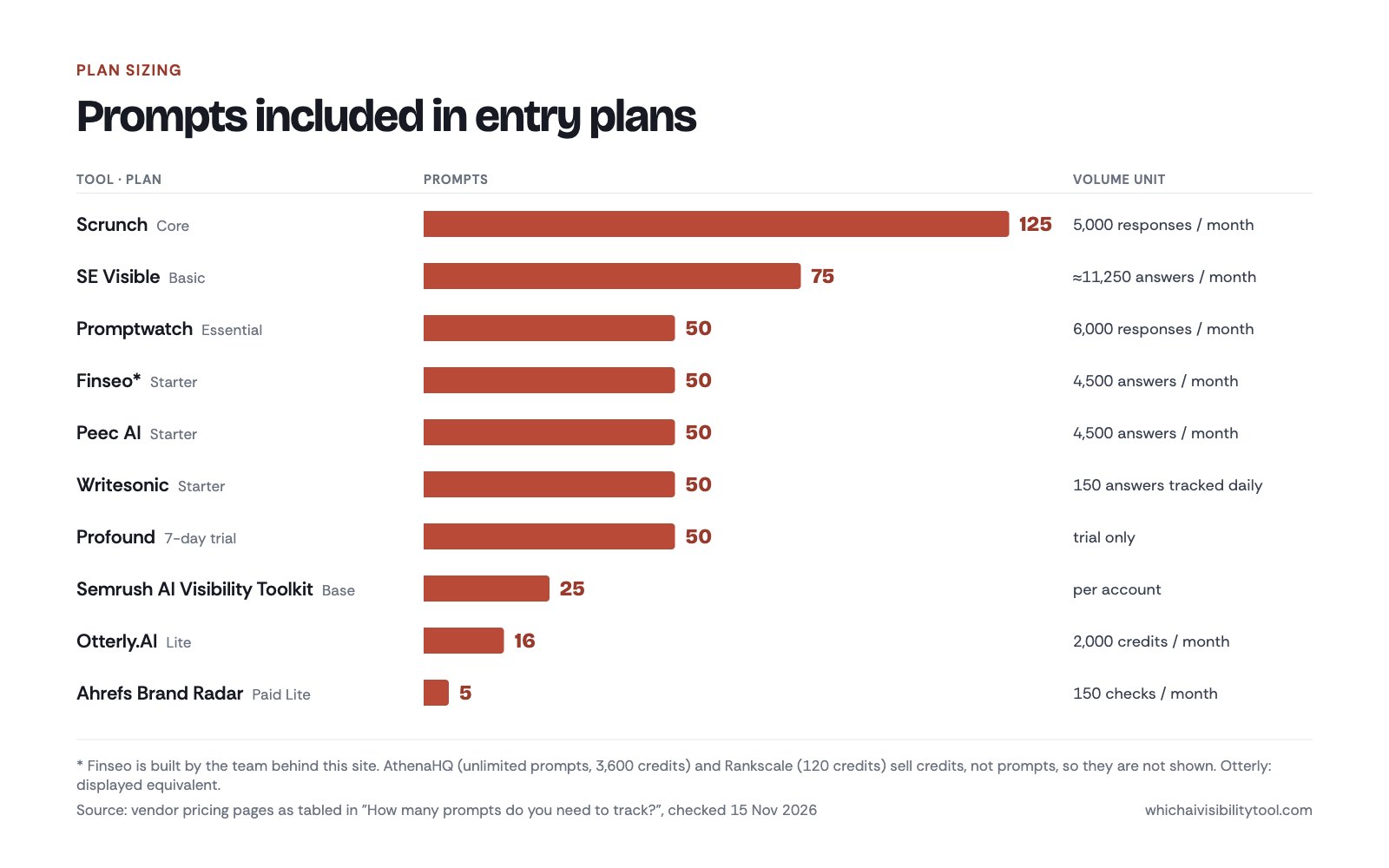
Most teams should begin with enough prompts to cover their core buying journeys, then size the plan by multiplying those questions by markets, engines, run frequency and repeated draws. For a small single-market program, 50 prompts across three engines can be a practical starting point; broader teams may need 150–200 prompts or an execution-based plan, depending on how many separate observations they require.[1]
What Is Prompt Sizing?
Prompt sizing is the process of estimating how many separately executed AI-search observations a visibility program needs. The number of unique question texts is only one input: a prompt may be tested across several engines, locations, languages, personas, days and repeated runs.
A useful planning identity is:
Answer executions = Q × M × V × E × D × F × RWhere:
- Q = distinct underlying questions
- M = markets or locations
- V = separately tested language or persona variants
- E = engines
- D = days in the planning period
- F = scheduled collections per day
- R = independent answer draws per collection
This extends the accounting rules published by monitoring vendors. Promptwatch defines responses as prompts multiplied by models and runs, while Peec’s agency documentation defines one prompt on one model for one day as one credit.[1][2] Athena’s calculator also includes prompts, locations, models and cadence.[3]
The same prompt count can represent very different workloads. Peec Starter lists 50 prompts, three models and 4,500 monthly AI answers, while Promptwatch Essential lists 50 prompts but 6,000 responses.[4][5] Compare prompt capacity, engine coverage and executed answers together.
Finseo is one example of a prompt-and-answer-volume model. Its Starter plan lists 50 prompts, 4,500 AI answers per month and three models at the same time; Business lists 150 prompts, 13,500 answers and three models.[6] Finseo is built by the team behind this site.
How Should You Calculate the Plan Size?
Use this five-step method before comparing pricing pages.
-
List the underlying questions. Group prompts by category, product, funnel stage, audience and competitor intent. Avoid filling the allowance with minor paraphrases: Peec recommends broad topic areas and intent categories, while Semrush recommends one or two representative phrasings for the same underlying need.[7]
-
Count separately tested markets and variants. A question tested in four locations may consume four prompt-location units. SE Visible explicitly counts each prompt once per location, with the allowance shared across projects.[8] Add separate language, persona or product variants only when they are actually tracked independently.
-
Choose the engines that matter. Decide whether every question must run on every engine or whether different prompt groups can use different engine sets. Three engines across 50 prompts create 150 prompt-engine combinations per collection; five engines across 200 prompts create 1,000.
-
Add the collection schedule. Daily tracking creates roughly 30 observations per month for each prompt-engine-market combination. Weekly tracking creates fewer observations but may be enough for slower-moving research. Do not assume a displayed monthly answer volume is a hard cap: SE Visible describes its monthly answer figures as approximate, while Promptwatch explicitly meters responses.[7]
-
Reserve capacity for repeated observations. One answer is one observation, not a reliable visibility estimate. If the goal is mention rate or citation rate, allocate enough repeated runs to the specific segment being reported rather than counting only the account-wide total.[9]
For credit-based tools, apply the vendor’s engine weighting instead of assuming one credit always equals one answer. Otterly states that one credit buys one prompt-engine check, while Rankscale says a typical engine query costs 0.25 credits and that costs vary by engine and collection method.[10][11] Ahrefs illustrates the difference by stating that Claude consumes eight checks per update.[12]
What Should Not Be Multiplied Automatically?
Competitors are usually a separate entitlement, not a simple execution multiplier. Peec includes unlimited competitors, while Scrunch Core allows five; Promptwatch’s response formula does not include a competitor term.[5] A competitor comparison may require an additional prompt, but every tracked prompt does not automatically need to be multiplied by the number of competitor names.
Projects, countries and languages also need separate checks. A plan can have enough prompt slots but too few projects, locations or supported engines. Treat those as constraints alongside the execution calculation.
How Do Published Plans Compare?
The table below uses public plan pages and help documentation. A 30-day calculation is arithmetic for comparison, not a claim that every vendor defines a billing month the same way.
| Tool | Entry plan | Prompts included | Engines at once | Run frequency | Source |
|---|---|---|---|---|---|
| Finseo | Starter | 50; 4,500 AI answers/month | 3 models of choice | Daily/weekly | |
| Peec AI | Starter | 50; 4,500 monthly AI answers | 3 active models | Daily | |
| Otterly.AI | Lite | Displayed equivalent of 16 prompts; 2,000 credits/month | Displayed configuration uses 4 of 7 engines | Daily | |
| Promptwatch | Essential | 50; 6,000 responses/month | All-model access | Daily | |
| Scrunch | Core | 125 unique prompts; 5,000 responses/month | 4 listed engines | Frequency not published | |
| AthenaHQ | Starter | Unlimited configured prompts; 3,600 credits/month | 11 models listed | Frequency not published | |
| SE Visible | Basic | 75 prompts; approximately 11,250 answers/month | 5 engines | Daily by default; weekly option | |
| Rankscale | Essentials | 120 credits; up to 480 answers | Engine-dependent | Hourly to monthly scheduling | |
| Writesonic | Starter | 50 prompts; 150 answers tracked daily | 3 engines | Daily | |
| Ahrefs Brand Radar | Paid Lite | 5 displayed AI prompts; 150 checks/month | Custom Prompts supports 7 named platforms | Daily updates for included allowance | [12] |
| Semrush AI Visibility Toolkit | Base | 25 tracked prompts/account | ChatGPT Search, Google AI Mode and Gemini for custom tracking | Daily for Custom Prompt Tracking | [13][7] |
| Profound | Trial | 50 unique prompts for 7 days | ChatGPT, Gemini and Google AI Overviews | Daily |
Checked against each vendor’s public pricing and product pages on 15 November 2026.
What Do These Numbers Mean in Practice?
Finseo Starter and Peec Starter both show the arithmetic of 50 prompts across three models for 30 days: 50 × 3 × 30 = 4,500 answer executions.[6] Their headline prompt allowances are therefore easier to compare than a credit-only plan, but the displayed answer volume still needs to be allocated across the selected conditions.
Promptwatch Essential’s published example is 50 × 4 × 30 = 6,000 responses, and Professional lists 150 prompts and 18,000 responses.[4] The platform states that each additional model adds a full set of responses.[14]
Otterly’s Lite plan uses a different unit. Its displayed 16-prompt, four-engine daily configuration consumes 16 × 4 × 31 = 1,984 credits in its 31-day example, within the 2,000-credit allowance.[15]
Scrunch shows why prompt count alone can mislead. Its Core plan lists 125 unique prompts and 5,000 responses per month, but 125 × 4 × 30 = 15,000 would be required for daily execution across four engines.[16][17] The published prompt ceiling therefore does not prove that all 125 prompts run daily on every supported engine.
SE Visible’s Basic plan lists 75 prompts, five engines and approximately 11,250 monthly answers, which corresponds to 75 × 5 × 30.[8] However, its prompt allowance is counted per location, so the same question in multiple locations consumes additional prompt units.[1]
Why Are Repeated Runs Necessary?
AI answers can change even when the underlying prompt remains identical. SparkToro’s research collected 2,961 executions of 12 prompts across three tools and found very low repetition of complete recommendation lists.[18] For ChatGPT and Google AI, repeating the same brand list across two responses occurred less than one time in 100, while repeating the list order occurred approximately one time in 1,000.[18]
A separate 2026 preprint studied repeated AI visibility observations across Gemini, SearchGPT and Perplexity. It reported median cited-source-set overlap of approximately 0.30 for Gemini, 0.40 for SearchGPT and 0.50 for Perplexity, supporting repeated sampling and uncertainty reporting.[16] Finseo’s own study of about 1.4 million German-language AI answers found the same pattern in DACH search: only 38.4% of URLs cited by ChatGPT for a prompt were still cited the next day, and on ChatGPT a single day of visibility missed the following fortnight by 16 points on average.
These findings measure different outcomes. Recommendation-list consistency, cited-domain overlap and brand-mention frequency are not interchangeable. A changing list can still contain a brand frequently: SparkToro reported that selected brands appeared in 55%–77% of 994 headphone-prompt responses, while Smartsites appeared in 85 of 95 Google AI responses for another category.[18]
The practical consequence is simple: use more distinct prompts for coverage, and more repeated runs for precision. Expanding the question list does not automatically provide a precise estimate for each existing prompt, market or engine.[9][18]
How many repeated answers are enough?
There is no universal AI-visibility sample-size rule. For a binary outcome such as “brand mentioned,” a standard population-proportion formula is n = ⌈z²p(1-p)/e²⌉; using p=0.50 and 95% confidence produces 97 observations for a ±10-percentage-point margin of error and 385 for ±5 percentage points.[9][19]
Those are planning calculations, not vendor minimums. They also assume conditions that may not hold for changing AI systems, and the AI-visibility preprint warns that non-stationarity can affect uncertainty estimates.[9] Treat them as a way to discuss precision, not as a guarantee that 97 runs produce a definitive answer.
How Many Prompts Does a Starting Program Need?
Profound recommends starting with 100 prompts and expanding from the resulting data, with a broader typical range of 100–1,000 prompts.[18][20] That is vendor guidance, not a statistically established minimum or a published recurring paid-plan allowance.
Peec recommends beginning with three to five broad topic areas and organizing prompts by informational, commercial and transactional intent.[1] Semrush recommends branded, category and competitor intent while avoiding redundant phrasing.[7]
A sound starting inventory usually includes:
- Branded questions
- Unbranded category questions
- Product and service comparisons
- Competitor and alternative queries
- Pricing and purchase-intent questions
- Problem-solving and informational questions
- Post-purchase or support questions
- Market- or language-specific variations
The goal is not to maximize the number of similar questions. It is to represent the situations in which prospective customers might ask an AI engine for help. Finseo’s own query fan-out study found that AI Mode rewrites one prompt into about nine synthetic searches, and 95% of them have zero search volume. That is a reason to choose prompts by buyer situation rather than by keyword volume.
Which Plan Fits Each Buyer?
Small Business: 16 Prompts Across Four Engines
Otterly Lite publishes 2,000 credits per month and displays an equivalent configuration of 16 prompts across four engines, checked daily.[21][15] Using the vendor’s 31-day basis:
16 prompts × 4 engines × 31 days = 1,984 creditsThat leaves 16 credits within the published allowance.[18] The remaining balance is not another full daily collection; it is only 16 individual prompt-engine checks.
Best fit: a small business that needs a compact daily watchlist across several engines and does not need a large multi-market prompt inventory.
In-House Brand Team: 150 Prompts Across Three Models
Peec Pro publishes 150 prompts, three active models, three countries and 13,500 monthly AI answers.[5] Keeping this example to one country avoids assuming an unpublished rule for duplicating identical questions across countries.
150 prompts × 3 models × 30 days = 13,500 answersThis uses the full 150-prompt allowance and reproduces the listed monthly answer volume.[7] It does not mean each question receives 13,500 observations; each prompt-model combination receives approximately 30 daily observations in the 30-day calculation.
Best fit: an in-house team covering several funnel stages, products or competitors across three principal AI engines.
Multi-Market Brand: 50 Questions in Four Locations
SE Visible Core publishes 200 prompts, five engines, approximately 30,000 monthly answers and 10 projects.[8] Because prompts count per location, four locations with 50 underlying questions each require:
50 questions × 4 locations = 200 prompt-location units
200 prompt-location units × 5 engines × 30 days = 30,000 answers
This uses all 200 prompt units and four of the ten projects.[9][16] The monthly answer figure is approximate, and the vendor does not publish an overage or interruption rule in the cited pricing information.[18][5]
Best fit: a multi-market brand whose primary sizing constraint is localized coverage rather than a very large number of global questions.
How Should You Compare AI Visibility Plans?
Compare plans in this order:
- Question coverage: How many genuinely different buyer needs must be represented?
- Engine coverage: Which models and AI search surfaces matter to the audience?
- Market coverage: Are countries, cities or languages counted separately?
- Execution volume: Is the allowance expressed as prompts, answers, checks or credits?
- Cadence: Does the plan run daily, weekly, hourly or on an unspecified schedule?
- Repetition: How many observations are needed for the metric being reported?
- Entitlements: Are competitors, projects, personas and countries included?
- Expansion path: Can additional engines, prompts or credits be added without changing platforms?
Credits are not directly comparable across vendors. Otterly uses one credit per prompt-engine check, Rankscale gives a typical 0.25-credit engine-query rate, and Ahrefs applies different check costs to platforms such as Claude.[11][5] Convert every plan into the workload your team actually needs before comparing price.
Frequently asked questions
How many prompts should I track for AI visibility?
Start with the distinct questions that represent your main categories, products, funnel stages and competitor situations. Profound recommends starting with 100 prompts, but that is guidance rather than a universal statistical minimum or a guaranteed paid-plan allowance.[9]
Is 50 prompts enough for an AI visibility tool?
Fifty prompts can be enough for a focused single-market program, especially if they run across several engines. Finseo Starter and Peec Starter both list 50 prompts and 4,500 monthly AI answers with three models, while Promptwatch Essential lists 50 prompts and 6,000 responses.[6] It may be insufficient for multiple markets, product lines or personas.
How many engines should each prompt run on?
Run a prompt on every engine that materially influences your audience, but do not assume every question needs every available model. Three models across 50 prompts create 150 prompt-engine combinations per collection; five models across 200 prompts create 1,000.
Do competitor brands multiply the number of prompts?
Not automatically. Competitors can be tracked as an entitlement or compared within answers, while separately written alternative and comparison questions may increase the prompt inventory.[5] Peec includes unlimited competitors, whereas Scrunch Core specifies five.[17]
Should AI visibility prompts run daily?
Daily tracking is useful when answers, citations or market conditions can change quickly, but weekly tracking may be sufficient for slower-moving programs. Published plans differ: Finseo, Peec and Promptwatch list daily or daily/weekly tracking, while some plans do not publish a cadence.[18]
How many repeated runs are needed for a reliable AI visibility rate?
There is no universally validated number. A standard 95%-confidence planning calculation requires 97 observations for a ±10-percentage-point margin of error under conservative assumptions, but changing AI systems may violate the independence and stability assumptions behind that calculation.[9][19] Report the segment, observation count and uncertainty rather than presenting one run as definitive.
Sources
- 1Setting up your prompts docs.peec.ai
- 2Pricing | Profound tryprofound.com
- 3Credit Calculator | Action on AI Search athenahq.ai
- 4Pricing | Promptwatch - AI Visibility & GEO Platform promptwatch.com
- 5Pricing for Peec AI - AI Search Platform for Marketing teams and SEO agencies peec.ai
- 6Pricing, Starter, Business, Growth & Enterprise | Finseo finseo.ai
- 7How to decide which AI search prompts to track semrush.com
- 8SE Visible: AI Visibility Platform by SE Ranking visible.seranking.com
- 9Quantifying Uncertainty in AI Visibility A Statistical Framework for Generative Search Measurement arxiv.org
- 10Understanding Credits and Usage | Rankscale HelpDesk help.rankscale.ai
- 11Pricing | Rankscale rankscale.ai
- 12Ahrefs Brand Radar: Study your brand’s AI visibility ahrefs.com
- 13AI Visibility Toolkit Pricing | Semrush semrush.com
- 14How to Manage Your Response Limit? promptwatch.com
- 15How many search prompts / keywords can I track? help.otterly.ai
- 16Quantifying Uncertainty in AI Visibility: A Statistical Framework for Generative Search Measurement arxiv.org
- 17Scrunch | Pricing scrunch.com
- 18NEW Research: AIs are highly inconsistent when recommending brands or products; marketers should take care when tracking AI visibility - SparkToro sparktoro.com
- 198.1.1.3 - Computing Necessary Sample Size online.stat.psu.edu
- 20How to Design Prompts for AI Visibility Tracking in 7 Practical Steps | Profound tryprofound.com
- 21OtterlyAI Pricing - Transparent & Simple otterly.ai